
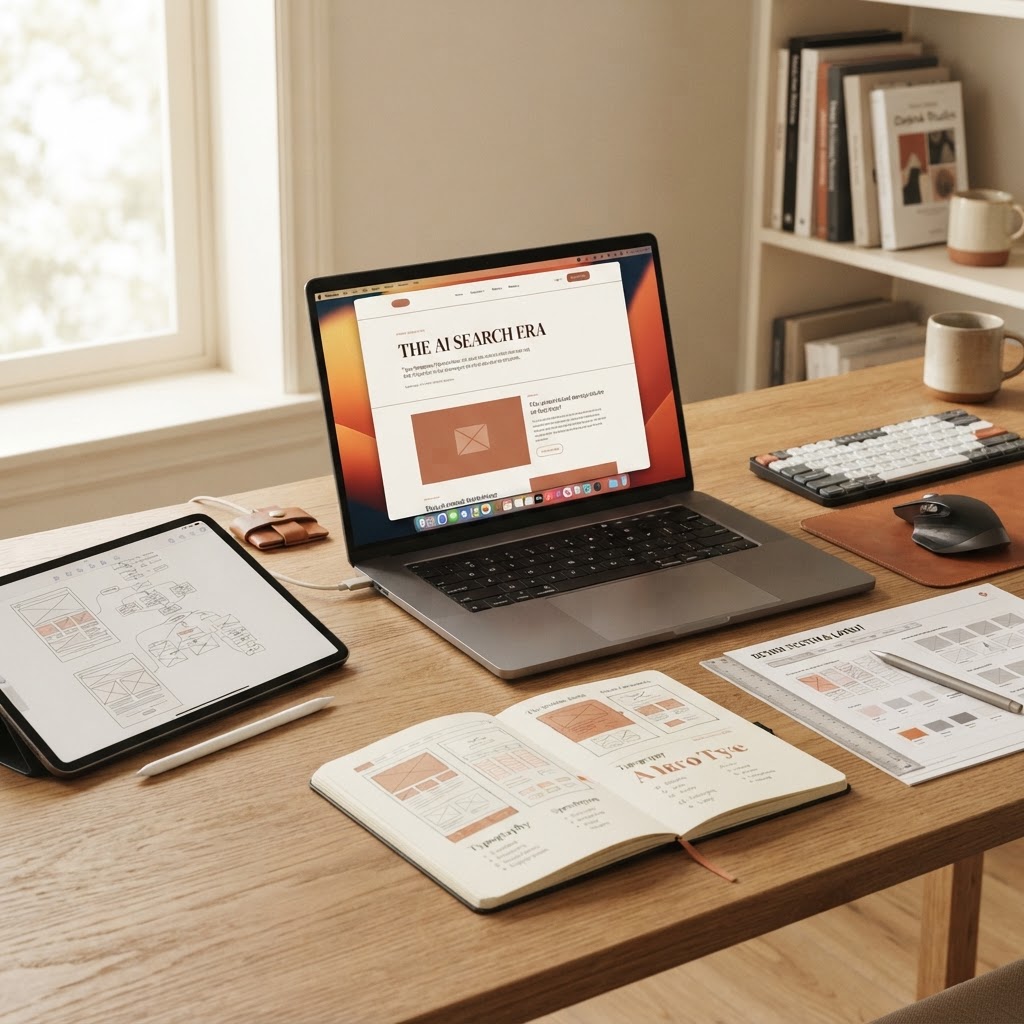
Search traffic is no longer a simple volume game. Search engines answer more questions directly, AI tools summarize entire categories in a paragraph, and the web is filling with competent-looking pages that nobody remembers five minutes later.
That is exactly why established brands should stop trying to outpublish machines.
The practical answer to the question is this: brands maintain search visibility and authority in the AI era by shifting from content volume to demonstrable authority — fewer, stronger pages; structured and quotable information; distinctive design; original expertise; and high-performance websites that convert the smaller share of traffic that still clicks through. In 2026, the winning AI-era SEO strategy is not to flood the index. It is to create a site that search engines can understand, AI systems can cite, and human buyers can trust immediately.
That shift is driving the rise of quiet web design 2026: a restrained, editorial, high-craft approach that replaces noise with clarity. For established companies and founders, it is becoming one of the most effective answers to zero-click search.
Why search visibility now depends on authority, not output
For years, brands could grow organic traffic by publishing at scale. That approach is weakening for three reasons:
- AI-generated volume has commoditized generic content. If a page says what a thousand other pages say, it is interchangeable.
- Zero-click search visibility is rising. Users often get enough information from search results, AI overviews, maps, and summaries without visiting the site.
- Clicks that do reach a website are higher stakes. Fewer visits means each one has to do more work.
For established brands, this changes the goal. The aim is no longer just "rank for more terms." The aim is to:
- appear credible enough to be cited or summarized
- attract branded and high-intent searches
- convert fewer visits at a much higher rate
- leave a distinct impression strong enough to generate return visits, referrals, and direct traffic
That is where high-craft design starts outperforming high-volume publishing.
What quiet web design means in 2026
Quiet web design is not minimalism for its own sake. It is a deliberate reduction of visual and editorial clutter so the brand's substance carries more weight.
In practice, quiet design usually includes:
- disciplined layouts with strong spacing
- editorial typography instead of default SaaS sameness
- restrained motion and interaction design
- fewer navigation choices, better information hierarchy
- original imagery, diagrams, or art direction
- fast, stable, accessible front-end performance
- concise copy that says something specific
It feels confident because it does not beg for attention.
Why quiet design improves engagement
High-volume content strategies often create bloated sites: repetitive articles, weak internal differentiation, thin templates, and pages built for keywords instead of readers. Visitors arrive, skim, confirm there is nothing special there, and leave.
Quiet design improves engagement because it does the opposite:
- It lowers cognitive load. Visitors understand where they are and what matters.
- It increases perceived quality. Care in typography, spacing, and image selection signals care in the business itself.
- It slows the right people down. A serious buyer will spend more time with a page that feels authored, not assembled.
- It sharpens recall. Distinctive presentation helps a brand remain memorable after the search session ends.
That matters in a fragmented search environment. If a buyer sees the brand in an AI summary, then later returns through direct or branded search, that is still search influence — just not the old last-click version of it.
The new SEO model: build pages worth citing, not just indexing
To maintain visibility and authority, established brands need pages that work in three layers at once:
1. Pages that search engines can parse
This still requires SEO fundamentals:
- clean information architecture
- descriptive titles and headings
- strong internal linking
- schema where appropriate
- concise answers near the top of the page
- stable mobile performance
None of that is glamorous, but it remains essential. AI systems and search crawlers still rely on structure.
2. Pages that AI systems can summarize accurately
In the AI era, many users encounter a brand through a summary before they ever see the site. That means pages should include:
- clear statements of expertise
- specific definitions and distinctions
- original points of view
- well-labeled comparisons
- concrete proof, dates, credentials, results, or process details
Generic writing gets paraphrased into invisibility. Specific writing earns attribution.
3. Pages that humans want to continue reading
This is where bespoke web design benefits become decisive. A page can be technically indexable and still fail because it looks disposable. Established brands need pages that make visitors think, within seconds, "this company knows exactly what it is doing."
Why editorial typography and bespoke art direction matter more now
In a web flooded with AI-generated text and template-based layouts, visual judgment has become a form of proof.
Editorial typography web design matters because type sets the tone before the copy is fully read. It communicates seriousness, clarity, pace, and taste. A brand using well-chosen type, disciplined rhythm, and readable measure appears more credible than one using a generic system font stack with cramped spacing and interchangeable blocks.
Bespoke art direction matters for the same reason. AI can produce infinite images, but infinite images do not create identity. Founders and established brands need visual systems that feel authored:
- custom illustration styles
- distinct photography direction
- original diagrams or product visuals
- thoughtful color restraint
- page compositions that support narrative, not just decoration
These are no longer aesthetic luxuries. They are competitive advantages. When every category fills with synthetic familiarity, recognizable craft becomes a trust signal.
LiveWebMedia has been building on the web since 1998, long enough to watch fashionable patterns cycle in and out of favor. The durable pattern is simpler: brands that look and read like themselves earn more trust than brands that look like everybody else.
Why Lighthouse 100 matters more when clicks are scarce
In a zero-click environment, each visit costs more to win. That raises the value of performance.
A high-performance site — ideally pushing toward Lighthouse 100 conversion impact territory on mobile fundamentals — affects both visibility and conversion.
Performance changes perception
Visitors make quality judgments fast. A site that loads instantly, responds smoothly, and feels stable creates an impression of operational competence. A slow or jittery site creates doubt before the sales message even begins.
Performance protects conversion
On high-intent pages, speed influences:
- bounce rate
- scroll depth
- form completion
- product exploration
- call scheduling or inquiry actions
- overall confidence in the brand
When traffic is thinner but more qualified, small losses hurt more.
Performance supports discoverability
Fast pages are easier to crawl, render, and use across devices. They also reduce the risk that rich results, summaries, or mobile visitors are undermined by poor execution. Performance is not separate from brand strategy anymore; it is part of it.
How to move from generic SEO to brochure-grade digital experiences
The strongest response to AI-generated volume is not anti-technology nostalgia. It is editorial discipline.
A brochure-grade digital experience does not mean static or old-fashioned. It means every page is intentional, polished, and built to support a buying decision.
Audit content by intent, not traffic
Start by sorting pages into four groups:
- high-intent commercial pages
- authority-building pages
- support/documentation pages
- low-value commodity pages
Then ask:
- Does this page answer a real buyer question?
- Does it offer something only this brand can say?
- Would its disappearance harm trust or sales?
- Is it strong enough to deserve maintenance?
Merge, rewrite, or remove pages that exist only to catch stray keywords.
Build fewer, stronger authority pages
Most established brands need a tighter core:
- homepage with a clear market position
- service or product pages with precise differentiation
- proof pages with case studies, outcomes, or examples
- expertise pages answering high-intent questions
- about/leadership pages that establish credibility
Each page should do more than rank. It should resolve doubt.
Write for citation and decision-making
To improve zero-click search visibility, structure pages so key points can be lifted cleanly into summaries while still giving users a reason to click.
Useful tactics:
- answer the core question in the first 100 words
- use short comparison sections
- include original frameworks or named methods
- publish clear, quotable statements of position
- support claims with specifics, not adjectives
The page should be summary-friendly without becoming summary-exhausted.
Replace stock sameness with authored design
This is where many brands still underspend. Anti-AI web design trends are not really anti-technology; they are anti-genericity.
Practical upgrades include:
- custom page compositions instead of repetitive block templates
- editorial typography with consistent scale and rhythm
- art direction that supports category position
- tighter copy editing so every sentence earns its place
- interaction design used sparingly and purposefully
The result is a site that feels like a considered publication, not a content warehouse.
Make performance a brand standard
A quiet site cannot be quietly slow.
Brands pursuing high-craft experiences should pair design ambition with technical restraint:
- compressed, responsive media
- font loading strategies that preserve speed and type quality
- lean front-end code
- static or hybrid rendering where appropriate
- accessibility baked into components
- strong caching and image delivery
The best sites in 2026 do not force a choice between beauty and speed.
Measure authority with better signals
Traffic alone is no longer a reliable scorecard. Better indicators include:
- growth in branded search
- direct traffic from remembered visits
- higher conversion rates on fewer sessions
- longer engagement on core pages
- more qualified leads or inquiries
- citations, mentions, and referrals from trusted sources
That is how established brands tell whether their authority is actually compounding.
What established brands should do next
To maintain search visibility and authority in 2026, brands should stop asking, "How can the site publish more?" and start asking, "What on this site cannot be copied, summarized away, or forgotten?"
The durable answer usually includes five moves:
- Reduce commodity content. Cut the pages that add volume but not distinction.
- Strengthen high-intent pages. Invest in the pages closest to trust and conversion.
- Design for recognition. Use quiet layout, editorial typography, and bespoke art direction to create memory.
- Build for speed. Performance is part of authority.
- Publish what AI cannot invent credibly. Real process, real opinions, real proof, real judgment.
That is the core of a modern AI-era SEO strategy. Search visibility still matters, but authority now depends on what happens after discovery: recognition, trust, and conversion.
High-craft websites are rising not because trends have changed, but because the economics of attention have. When the web fills with generated volume, quiet precision starts to look like the rarest thing on the page.
Frequently Asked Questions
Is quiet web design just another form of minimalism?
No. Minimalism often describes a visual style. Quiet web design is a strategic approach that removes noise so clarity, performance, typography, and brand substance do more of the work.
Can a smaller site really outperform a large content library?
Yes, if the smaller site is built around high-intent pages with stronger differentiation and better conversion. In the AI search era, fewer authoritative pages often outperform large libraries of generic articles.
Does Lighthouse 100 really affect conversions?
It can, especially on mobile and high-intent landing pages. Fast, stable pages reduce friction, improve trust, and help more of the traffic that does arrive actually complete the next step.